
How to Search Delaware County Court Records
There are two official ways to look up a Delaware County court case. The county runs Delaware County Public Access for local court records, and the state runs the Pennsylvania UJS Web Portal for statewide dockets and docket sheets. Use the county portal first for local civil and case data. Use the state portal for Common Pleas docket numbers, Magisterial District Judge cases, and court calendars. Both are free to search. Neither charges to view a docket sheet, though certified copies cost money and come from the clerk.
Before you start, gather what you know. A docket number gives the cleanest result. A full name works too, but common names return long lists, so a date range helps narrow things.
- Open the Delaware County Public Access portal and turn on JavaScript. The site will not load without it.
- Enter a case number if you have one. The quick search treats your text as a case number with a "starts with" match.
- To search by party name, use the Pennsylvania UJS portal. Start with the last name, then add a first name or filing date if too many cases appear.
- Pick the court type. Choose Common Pleas for major cases or Magisterial District Judge for traffic and local matters.
- Open the docket. Review the parties, charges, hearing dates, and disposition, then ask the clerk for a certified copy if you need one for court.
The two systems work together. A docket entry tells you an event happened. It is not always the actual order or pleading, and some documents stay with the clerk.
Court records are searched through the Delaware County Public Access portal, the county's own court records site.
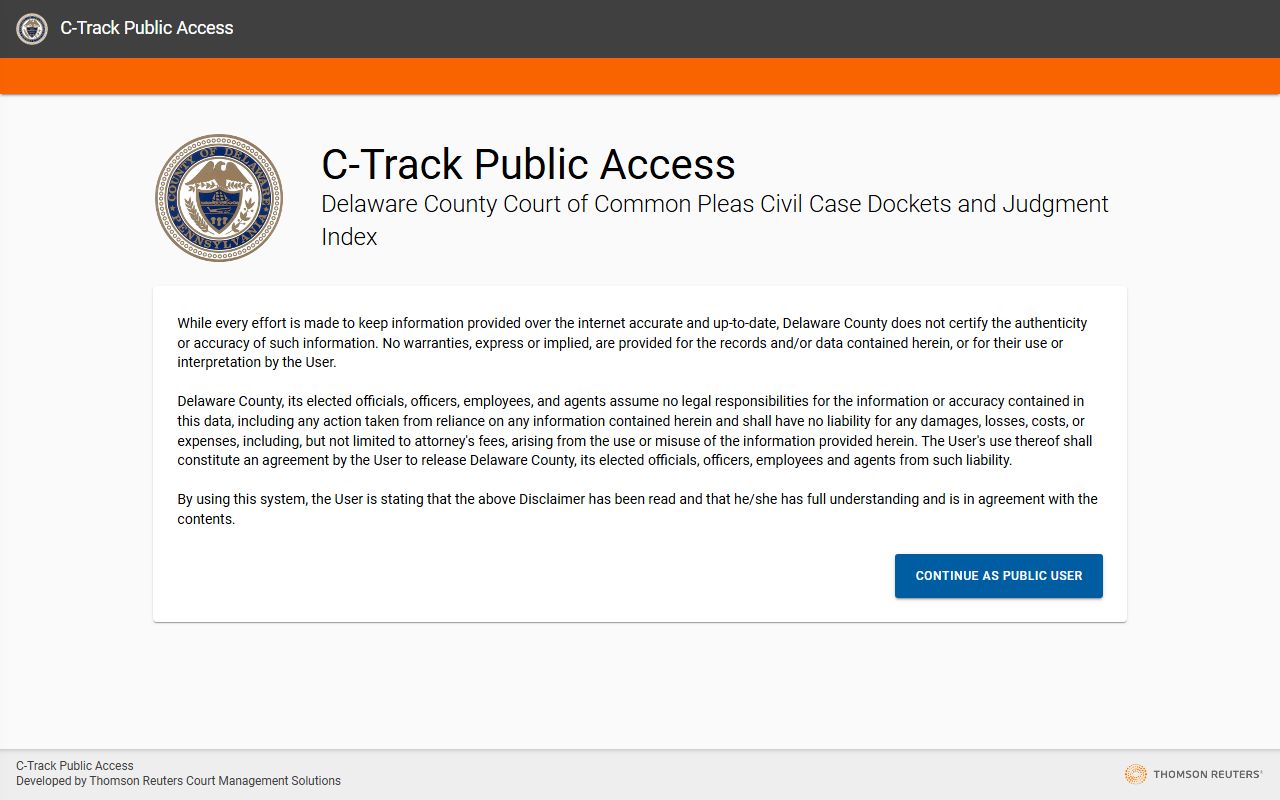
The portal runs as a JavaScript app, so plan to search it in a current browser rather than expecting a plain web page.
Search Fields on the Statewide Court Portal
The Pennsylvania UJS portal asks for a few key fields. You do not need to fill every box. The most reliable search uses a known docket number. When you only have a name, the county and court type fields keep the results focused on Delaware County.
| Field Label | Type | Required | Notes / Format |
|---|---|---|---|
| Court Type | Dropdown | Yes | Common Pleas, Magisterial District Judge, or appellate, depending on the page. |
| County | Dropdown | For county searches | Select Delaware to limit results. |
| Docket Number | Text | No | Criminal cases often read CP-23-CR-0000000-YYYY; 23 is the Delaware County code. |
| Participant Name | Text | No | Last name and first name fields, or a combined participant search. |
| Date Filed | Date range | No | MM/DD/YYYY; use it to trim a large result set. |
| MDJ Court Number | Text | No | Use the 32-x-xx court number for a Magisterial District case. |
Magisterial cases search faster through the MDJ docket tool than through the Common Pleas tool. Match the field to the court that heard the case.
The Delaware County Judicial System
Pennsylvania uses a layered court system, and Delaware County fits inside it. The Court of Common Pleas is the county's general trial court. Above it sit three statewide courts that hear appeals. Below it sit the Magisterial District Courts, which handle the high-volume local cases that most residents meet first. Delaware County is the 32nd Judicial District, and its trial court is based in Media.
Case flow: Magisterial District Court › Court of Common Pleas › Superior Court or Commonwealth Court › Supreme Court of Pennsylvania
| Court | Jurisdiction | Case Types |
|---|---|---|
| Supreme Court of Pennsylvania | Highest state court | Discretionary review; statewide court rules |
| Superior Court | Intermediate appeals | Most criminal, civil, family, and Orphans' Court appeals |
| Commonwealth Court | Intermediate appeals | Government, agency, election, and public-sector cases |
| Court of Common Pleas | County trial court (32nd District) | Felonies, major civil, family, juvenile, probate |
| Magisterial District Courts | Local limited jurisdiction | Traffic, summary offenses, small claims, landlord-tenant, preliminary hearings |
The two trial-level courts split the work in a clear way. The table below shows how the Court of Common Pleas differs from a Magisterial District Court.
| Feature | Court of Common Pleas | Magisterial District Court |
|---|---|---|
| Level | General trial court | Local limited-jurisdiction court |
| Criminal role | Felony and misdemeanor trials, sentencing | Preliminary arraignment and preliminary hearing |
| Civil role | Larger lawsuits, divorce, custody, estates | Small civil claims, landlord-tenant |
| Where | Media courthouse complex | Local offices across the county |
The county courts landing page is the gateway to each division and office.
You can see the full court structure on the Delaware County Courts page, which lists divisions for the 32nd Judicial District.
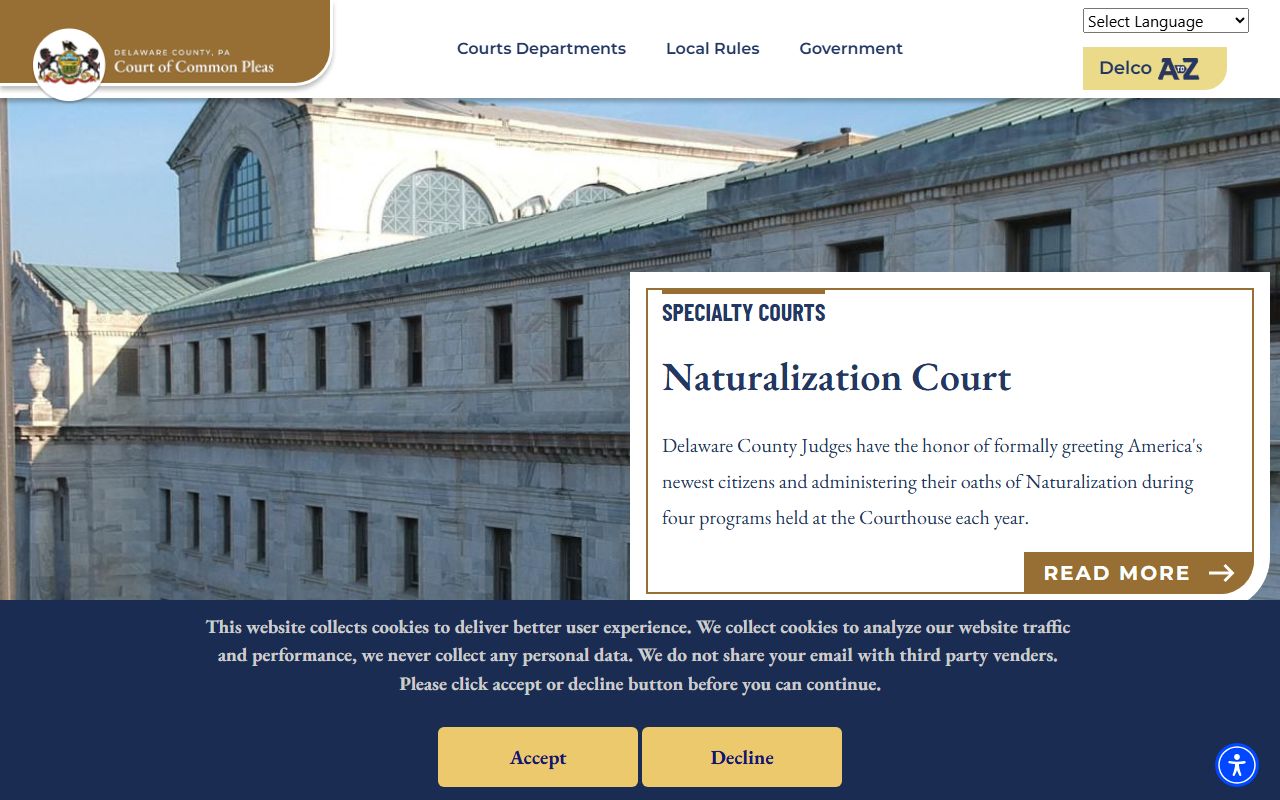
From that page, court users reach the trial court, district judge administration, and family court functions in one place.
Delaware County Courthouses and Court Offices
Most court business in Delaware County runs through Media. The courthouse and the county government complex hold the trial court, the records office, and the Register of Wills. The county jail sits outside Media in Thornton. The offices below cover filing, records, estates, and custody questions. Each office keeps its own public counter and its own hours, so call the right one before a trip.
George W. Hill Correctional Facility
500 Cheyney Road
Thornton, PA 19373
610-361-3200
The county's main website ties all of these offices together.
The Delaware County government homepage links to courts, the sheriff, the prison, the Register of Wills, and the District Attorney.
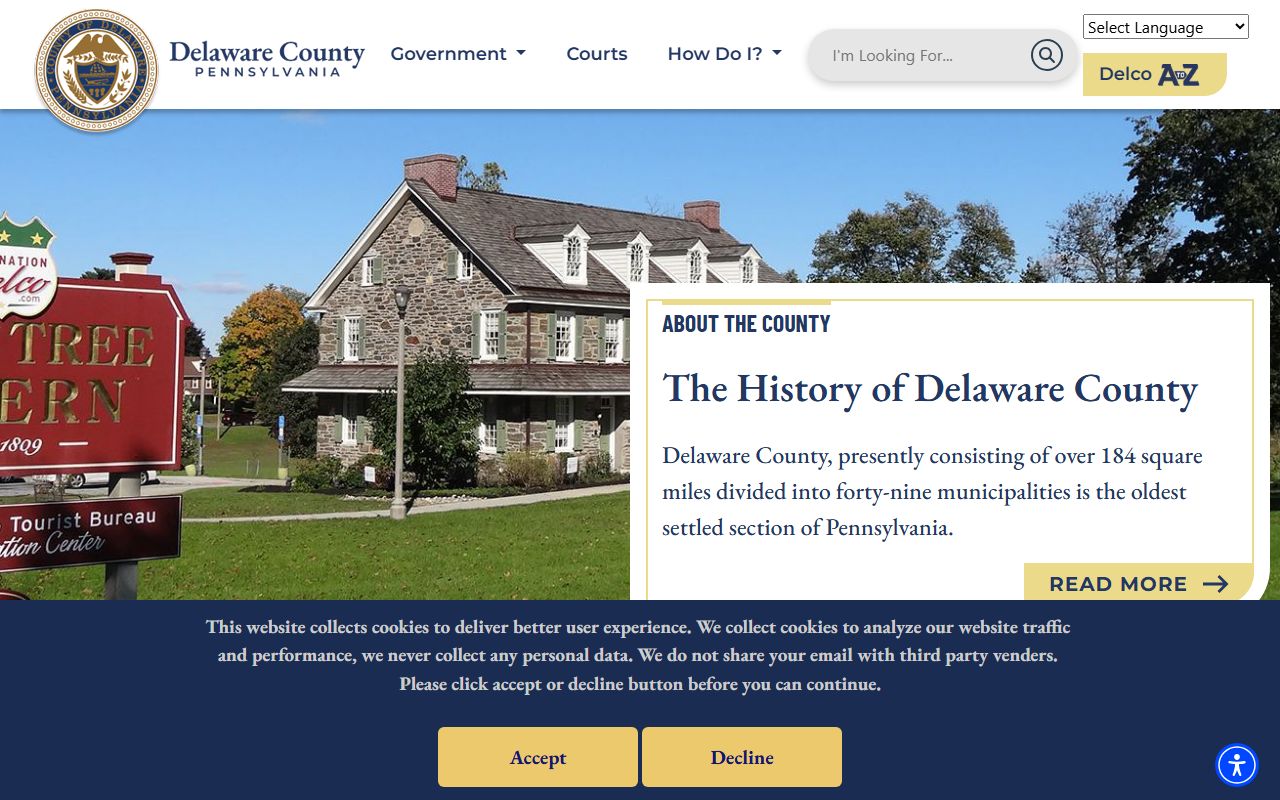
Use that homepage as a starting point when you are not sure which office keeps the record you want.
Types of Court Records Available in Delaware County
Delaware County court records fall into a handful of broad groups. The Court of Common Pleas produces civil, criminal, family, juvenile, and Orphans' Court records. The Magisterial District Courts produce traffic, summary, small-claims, and landlord-tenant records. The Register of Wills keeps estate and marriage records. Some records are open the moment they are filed. Others are sealed, redacted, or limited by law.
Here is how the main record types break down.
- Criminal records - Common Pleas dockets, MDJ preliminary matters, charges, pleas, sentences, fines, and restitution.
- Civil records - lawsuits, judgments, liens, and arbitration awards in the Court of Common Pleas.
- Family records - divorce, custody, support, and protection from abuse filings, with many parts restricted.
- Probate records - wills, estates, letters, and guardianships through the Register of Wills and Orphans' Court.
- Traffic records - citations, dispositions, fines, and payment status at the Magisterial District Courts.
The county lists each court department in one place.
The Delaware County courts departments page names the offices behind each record type.
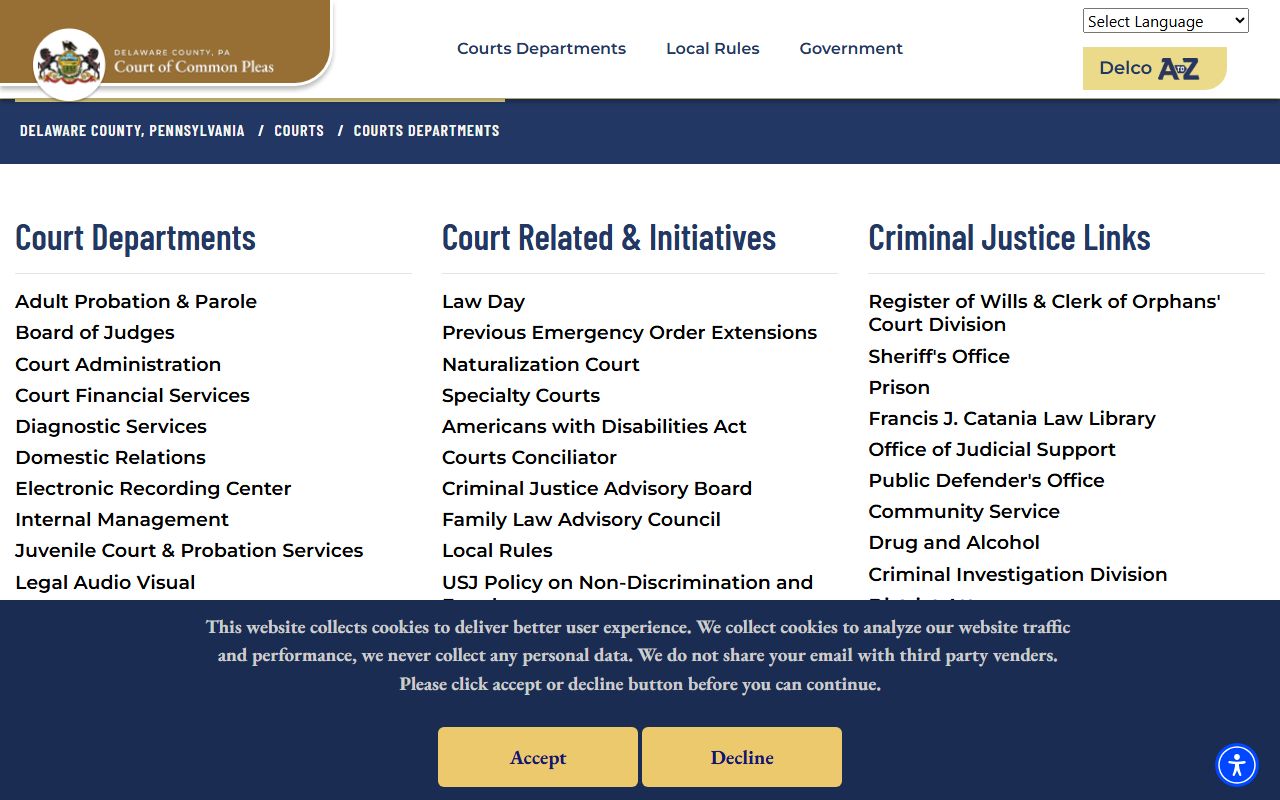
That list helps you match a record type to the office that holds it before you file a request.
What Delaware County Court Records Show
A court record is built from a set of standard fields. Once you learn them, every docket reads the same way. The fields below appear on most Common Pleas and Magisterial District dockets, though criminal and civil cases use slightly different labels. Sensitive items such as full dates of birth, Social Security numbers, and victim addresses are redacted under court policy.
| Field | What It Shows |
|---|---|
| Docket Number | The case ID; criminal Common Pleas cases use a CP-23-CR format. |
| Court | Court of Common Pleas of Delaware County or a named Magisterial District Court. |
| Filing Date | When the case opened. |
| Parties | Commonwealth versus a defendant, or plaintiff versus defendant. |
| Charges or Cause | Statute, grade, and offense description, or the civil claim. |
| Disposition | Current or final outcome, such as guilty, dismissed, or settled. |
| Financials | Fines, costs, restitution, bail, and any balance owed. |
Read the docket entries in order. They form a timeline of the case from the first filing to the last order.
Public Access Laws for Delaware County Court Records
Pennsylvania splits public records into two tracks. County agency records, like contracts and budgets, fall under the Right-to-Know Law and the Office of Open Records. Court case records follow the judiciary's own public access rules, not the same agency process. That difference matters. A request for a county contract and a request for a sealed criminal exhibit travel different paths.
Several Pennsylvania statutes shape what you can see and what stays closed.
Key Statutes:
Pennsylvania Right-to-Know Law (65 P.S. § 67.101) - presumes access to county agency records unless an exemption applies.
18 Pa.C.S. § 9122 - controls expungement of criminal history record information.
18 Pa.C.S. § 9123 - allows expungement of eligible juvenile records.
42 Pa.C.S. Chapter 63, Juvenile Act - keeps most juvenile proceedings confidential.
23 Pa.C.S. § 2907 - makes adoption records confidential, opened only by statute or court order.
The state judiciary also publishes its own access policy, which governs what appears online versus what stays at the courthouse counter. You can read it on the Pennsylvania courts public records page.
Records That Are Restricted or Confidential
Not every court record is open. Pennsylvania law shields several categories. Juvenile delinquency and dependency files are limited to parties, counsel, agencies, and people the court approves. Adoption records are confidential. Expunged and limited-access records drop out of ordinary public view after a court order. Mental health proceedings, grand jury materials, and sealed warrants stay closed as well. Even in an open case, the clerk redacts account numbers, full birth dates, and the addresses of protected parties.
To view a sealed record, you usually have to file in the court that handled the case. You name the docket numbers, state the legal basis, serve the right agencies, and ask the judge for an order. The public records page covers the Right-to-Know route, and the arrest records page covers expungement in more detail.
Specialty Courts in Delaware County
Pennsylvania counties often run problem-solving courts for people whose cases involve addiction or mental illness. These programs aim at treatment and supervision instead of a standard sentence. Placement is case-specific. It usually needs sign-off from the prosecutor, the defense, a treatment provider, and the judge.
Delaware County handles eligibility through Court Administration, the District Attorney, and the Public Defender. Anyone who thinks a treatment-court or diversion track might fit a case should ask one of those offices directly, because the criteria change with the charge and the person's history. Do not assume a program exists for a given charge without confirming it with the county.
Delaware County Sheriff and Jail
The Delaware County Sheriff's Office handles court security, civil process, sheriff sales, and court-ordered warrants. The county jail is George W. Hill Correctional Facility in Thornton, which the county brought back under public control after years of private management. In February 2026, the county Jail Oversight Board named Willie Bonds as warden. The official prison pages are the controlling source for custody, bail, mail, and visitation.
For the full roster and custody details, see Delaware County inmate records. For active warrants, see warrant records. To check on someone after release, see released inmates. The Sheriff's Office page covers process and sales.
Marriage, Divorce, and Orphans' Court Records
Two different offices handle these records. The Register of Wills issues marriage licenses and keeps estate and probate files as Clerk of Orphans' Court. Divorce is different. A divorce is a Common Pleas family case, filed through the Office of Judicial Support, not the Register of Wills. Protection from Abuse cases also run through the family side of the trial court.
Start with marriage and divorce records for license and divorce searches, or with Orphans' Court and probate records for wills and estates. A few estate terms come up again and again.
- Testator
- The person who made a will.
- Executor
- The person named in a will to settle the estate.
- Intestate
- Dying without a valid will.
- Orphans' Court
- Pennsylvania's court division for estates, wills, and guardianships.
The county's Protection from Abuse page explains how the family court handles safety orders.
The Delaware County PFA page walks through protection from abuse filings.
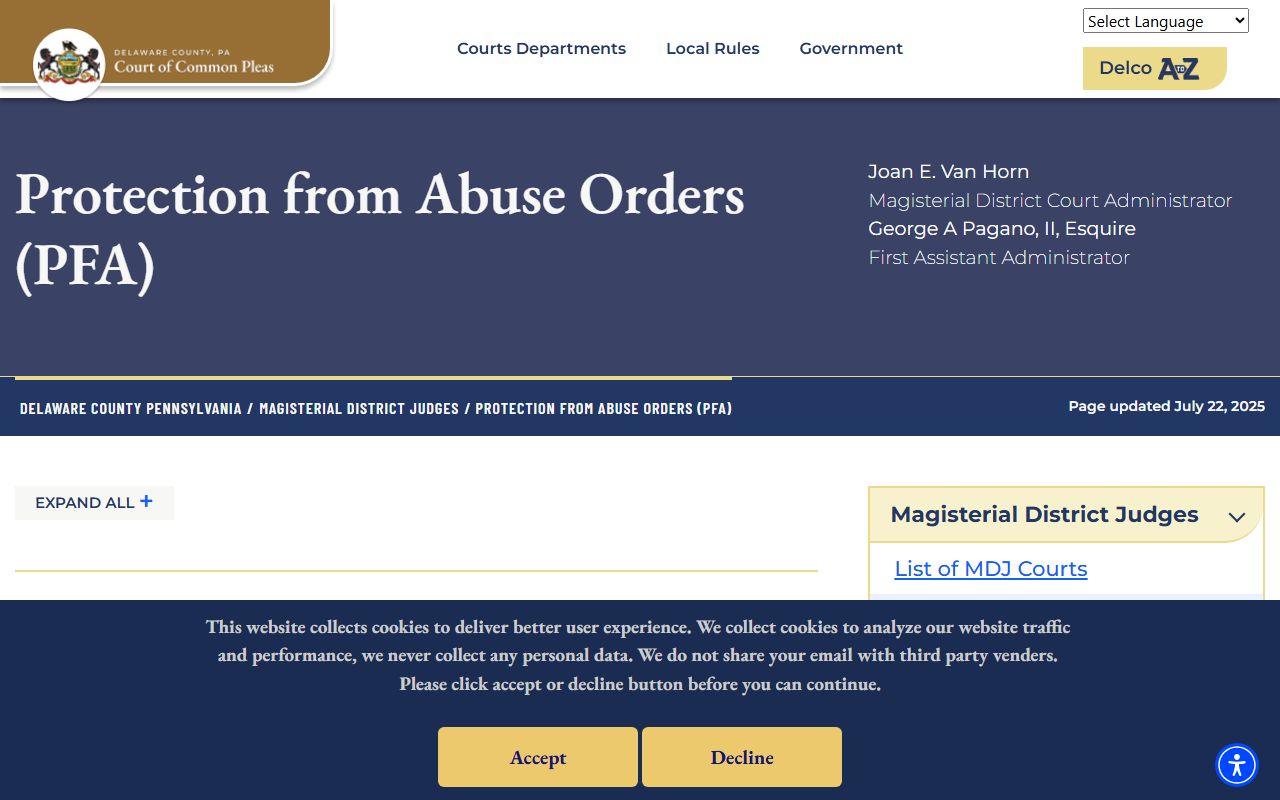
PFA records carry public and restricted parts, so addresses and details about minors are kept out of public view.
Delaware County Court Records Fees
Searching a docket online is free. Copies are not. The clerk charges for plain copies, certified copies, and certain searches. Exact amounts are set by current office fee schedules, and they change, so confirm the price with the office that holds the record before you pay. The table below shows where each fee is set rather than a dollar figure, since official amounts should be verified at the source.
| Record or Service | Where the Fee Is Set |
|---|---|
| Plain court copy | Office of Judicial Support fee schedule |
| Certified court copy | Office of Judicial Support fee schedule |
| Marriage license | Register of Wills fee schedule |
| Probate filing | Register of Wills fee schedule |
| Right-to-Know copies | Office of Open Records duplication rates |
Bring a payment method that the office accepts. Cash, card, and check rules differ by counter.
How to Interpret Delaware County Court Records
Docket language can trip people up. A charge is not a conviction. An arrest shows that police filed a case, not that a court found someone guilty. The disposition field is the one to read for the outcome. Words like "withdrawn," "dismissed," "held for court," and "guilty plea" each mean something different.
Watch the docket-number format too. Common Pleas criminal cases read CP-23-CR with the year, where 23 is the Delaware County code. Magisterial cases use an MJ-32 format, where 32 marks the 32nd Judicial District. If a number does not match the court you expect, you may be reading the wrong case.
Accuracy and Record Limitations
Online dockets update on the court's schedule, not in real time. A recent filing, plea, or payment may take days to appear. A docket sheet also is not the full file. The underlying motion or order may sit with the clerk, sealed, or simply not be posted online.
Note: Always confirm a name, charge, or disposition with the originating court office before you rely on an online record for any legal or personal decision.
History of Delaware County Courts
Delaware County is one of Pennsylvania's historic Philadelphia-area counties, with Media as its county seat. Its court system follows the state's Court of Common Pleas model, which gives the county trial court broad power over civil, criminal, family, juvenile, and Orphans' Court matters. Over time, Pennsylvania pulled many docket and access functions into the statewide UJS portal, while each county kept its own filing offices and local public access tools.
The Office of Judicial Support reflects that local structure. It blends the old roles of Prothonotary, who handled civil filings, and Clerk of Courts, who handled criminal filings. The Register of Wills carries on the older Pennsylvania probate tradition as Clerk of Orphans' Court. The return of the George W. Hill jail to county control is the county's most active recent criminal-justice story.
Frequently Asked Questions
How do I search Delaware County court records?
Use Delaware County Public Access for local court records and the Pennsylvania UJS portal for statewide dockets. Search by exact docket number when you have one. For Common Pleas criminal cases, use the CP docket number or a party name. For traffic and landlord-tenant matters, use the Magisterial District docket search. More tips live on the court records page.
What court handles major cases in Delaware County?
The Court of Common Pleas is the county's general trial court. It hears major civil cases, felonies, family and divorce matters, juvenile cases, and probate. Delaware County is Pennsylvania's 32nd Judicial District. The Court of Common Pleas page covers it in full, including the Magisterial District Court list.
Are all court documents online?
No. Docket sheets may be online while the underlying documents stay restricted, sealed, or available only from the clerk. Certified copies usually require direct contact with the Office of Judicial Support or the Register of Wills.
More answers are on the Delaware County Court Records FAQ page.